Panthéon
Paris, France Get Directions
Table of Contents
About Panthéon - Information center
Reviews and news for “Panthéon”
- UEMF and Paris 1 Panthéon-Sorbonne Inaugurate Shared International Campus in Fez Morocco World News
- France’s Paris 1 Panthéon-Sorbonne opens shared campus in Morocco, giving African students access to French programmes without moving to Paris Business Insider Africa
- Visiting the Panthéon: everything you need to know to discover it with your family Sortir à Paris
- Atelier HA designs MELT’s new Panthéon restaurant in Paris ICON Magazine
- Visiting Marc Bloch at the Panthéon: Dilexit Veritatem Medievalists.net
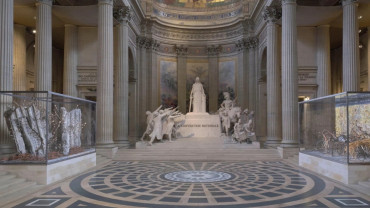
The Panthéon (French: [pɑ̃.te.ɔ̃] , from Ancient Greek πάνθειον (pántheion) '[temple] to all the gods') is a monument in the 5th arrondissement of Paris, France. It stands in the Latin Quarter (Quartier Latin), on the Montagne Sainte-Geneviève, in the centre of the Place du Panthéon, which was named after it. The edifice was built between 1758 and 1790, from designs by Jacques-Germain Soufflot, at the behest of King Louis XV; the king intended it as a church dedicated to Saint Genevieve, Paris's patron saint, whose relics were to be housed in the church. Neither Soufflot nor Louis XV lived to see the church completed.
By the time the construction was finished, the French Revolution had started; the National Constituent Assembly voted in 1791 to transform the Church of Saint Genevieve into a mausoleum for the remains of distinguished French citizens, modelled on the Pantheon in Rome which had been used in this way since the 17th century. The first panthéonisé was Honoré Gabriel Riqueti, comte de Mirabeau, although his remains were removed from the building a few years later. The Panthéon was twice restored to church usage in the course of the 19th century—although Soufflot's remains were transferred inside it in 1829—until the French Third Republic finally decreed the building's exclusive use as a mausoleum in 1881. The placement of Victor Hugo's remains in the crypt in 1885 was its first entombment in over 50 years.
The successive changes in the Panthéon's purpose resulted in modifications of the pedimental sculptures and the capping of the dome by a cross or a flag; some of the originally existing windows were blocked up with masonry in order to give the interior a darker and more funereal atmosphere, which compromised somewhat Soufflot's initial attempt at combining the lightness and brightness of the Gothic cathedral with classical principles. The architecture of the Panthéon is an early example of Neoclassicism, surmounted by a dome that owes some of its character to Bramante's Tempietto.
In 1851, Léon Foucault conducted a demonstration of diurnal motion at the Panthéon by suspending a pendulum from the ceiling, a copy of which is still visible today. As of December 2021 the remains of 81 people (75 men and six women) had been transferred to the Panthéon. More than half of all the panthéonisations were made under Napoleon's rule during the First Empire.
Where to get tickets for Panthéon events:
Directions: Get to Panthéon.Events in Panthéon: Find tickets in "Panthéon"